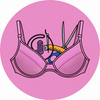

Behind the Scenes: How We Create Our Hand-Dyed Findings Kits
Have you ever wondered what actually goes into creating one of our matching Findings Kits?
At first glance, it might seem fairly simple: choose a colour, dye some elastics and put everything together.
In reality, there is quite a bit more happening behind the scenes at Bra Makers South Africa.🎨🧵
I recently asked our bra-making community which colours they struggle to find in South Africa, and I received some lovely suggestions — from yellows and greens to blues, pinks and dark brown.
Before introducing more colours, I thought it would be interesting to show you exactly what goes into creating them.
It Starts With The Lycra
I don't simply order a box of matching elastics in a new colour.
I purchase the Lycra first, and then I hand dye the elastics and hooks & eyes to coordinate with it.
This means I am working towards a particular colour rather than simply dyeing everything and hoping I can find fabric to match afterwards.
And this is where things start getting interesting...
Why Is Every Dye Batch Slightly Different?
Even when I use the same dye colour, the same measurements and follow the same process, there can still be slight variations in the finished shade.
There are several variables that can influence how the dye takes to the different materials.
One of these is the pH level of the water. The pH can vary, which can affect how the dye reacts and how the colour is taken up by the elastics.
Temperature also matters, as does the type of elastic being dyed. Different elastics contain different fibres, and those fibres don't necessarily absorb the dye in exactly the same way.
So even when I'm trying to recreate exactly the same colour, the finished result can vary slightly from one batch to another.
That's simply part of working with hand-dyed products — and part of what makes every batch a little unique.
Before Anything Goes Into The Dye Pot...
There is quite a bit of planning and preparation involved before I even start dyeing.
First, I have to decide what I actually want to do with the colour:
- Will it become a Findings Kit?
- Will I use it for a complete Bra Making Kit?
-
Or should I stock and sell each matching component individually?
That decision determines how much of each elastic, hooks & eyes, lace and other coordinating materials I need to prepare — and how much stock I need to commit to that particular colour.
Only then can I start measuring and cutting everything for the dye pot.
I Have To Allow For Shrinkage Too
The correct amounts of elastic and hook & eye tape needs to be measured and cut before dyeing.
But I can't simply cut the exact finished length that I need.
The elastics and hook & eye tape will become shorter during the dyeing process, so I have to take the expected shrinkage into consideration when preparing everything.
This is especially important when the components are being prepared for Findings Kits, because every kit needs to contain the correct amount once the dyeing process is complete.
Then The Dyeing Begins🎨
Even a light colour such as light pink can take 2 to 3 hours to dye.
That includes the preparation and several separate dye batches, because I simply cannot fit everything into one pot.
The pot itself takes around 15 to 20 minutes to reach the correct temperature.
Once it reaches the right temperature, I need to keep that temperature as consistent as possible throughout the dyeing process.
Each batch needs to be carefully monitored before I can move on to the next one.
This isn't really a job where I can put everything in the pot and walk away!
💡Fun Fact: Hooks & Eyes Take The Longest To Dye!
This might surprise you.
Of all the components that go into a Findings Kit, the hooks & eyes generally take the longest to dye.
Whether I'm working with laser cut hooks & eyes or hook & eye tape, they tend to take longer to absorb the colour than the elastics.
So while they may be one of the smallest components in the finished kit, they can actually be one of the most time-consuming parts to get just right.
It's another reason why creating a matching Findings Kit involves quite a bit more than simply putting a few elastics together.😊
Dyeing Days Need My Full Attention
While I'm dyeing, the dye bath needs my full attention.
I need to monitor the temperature, watch how the different materials are taking the colour and make adjustments when necessary.
Stepping away at the wrong time can affect the colour of an entire batch.
This is why, on dyeing days, I may not be able to answer messages, calls, pack orders or attend to admin while I'm actively working with the dye.
Once I start a batch, I need to finish what I'm doing before I can safely move on to something else.
And Then Everything Has to Dry...
Once the dyeing is finished, everything is hung up to dry.
And here's another little behind-the-scenes reality...
Have you ever tried to detangle 100 metres of wet elastic so that you can hang it up to dry?🤭
It feels like forever just trying to untangle everything before I can even start the process of hanging it up.
And yes, of course, just when I think I've finally got all the tangles out, there will be more tangles while I'm hanging it — because apparently the elastic likes to make life interesting!😂
Once everything is finally untangled and hanging up, it needs time to dry.
If I start dyeing early enough in the morning and everything dries in time, the finished elastics can sometimes be packed and sent to customers that same afternoon.
Otherwise, everything is left to dry indoors overnight.
Then I come back the next morning and check the colour again.
Sometimes I look at it and think...
"Nope. Not quite right yet."🤭
And then it's back to the dye pot for another round!
Why I Might Be Considering Limited Edition Colours
All of this brings me back to the question that started this discussion:
Which colours would you like to see more of?
Introducing one new colour isn't necessarily as simple as adding one new Findings Kit.
- If I introduce a new colour, should I also keep matching Lycra, lace and stabiliser netting?
- Should all the individual findings be available separately?
- Should it become a complete Bra Making Kit?
- Suddenly, one new colour can become quite a large range of stock.
And because every hand-dyed batch can vary slightly, keeping exactly the same shade available indefinitely isn't always practical.
That's why I might be considering introducing some of the more unusual colours as Limited Edition Findings Kits.
A limited quantity would be created from one dye batch. Once that particular batch is sold, that exact shade may not be available again.
I think that could also make them rather special. 💕
Now I Need Your Help!🌈
This is where your feedback really helps me decide what is worth putting into the dye pot next.
Which colours are you struggling to find in bra-making supplies?
💛 Yellow
💚 Green
💙 Blue
🩷 Pink
🤎 Dark brown
💜 Purple
❤️ Red
🌈 Something completely different?
And if I introduce a new colour, what would you actually like to have available?
Would you prefer just a Findings Kit, or would you also want matching Lycra, lace and other coordinating fabrics?
I'd much rather find out what South African Bra Makers actually want before investing in a large new range of stock.
Your feedback helps me decide which colours and coordinating materials will be genuinely useful — and, of course, what goes into the dye pot next.🎨🧵💕
Happy Sewing!
Bra Makers South Africa
0 comments